
Leflore Current-Owner Record Card
The Leflore parcel layer stores the current owner in OWNERNAME. The Tri-State result table calls the same field OWNER. Neither label captures every title interest on its own, so the surrounding fields supply the context any owner check needs.
| OWNERNAME / OWNER | The assessor's current owner label |
|---|---|
| ADDRESS1–3 | Lines used for owner tax mail |
| SITUS_ADDR | The property location, when present |
| PPIN / PARCEL_ID | Keys tying the name to one tract |
| DEED_BOOK / PAGE | The recorded-instrument handoff |
| DEED_DATE | Date carried in the parcel record |
Owners do not always live on the land. One rural parcel shows a post-office box in Sumner. Another uses a county-road mailing line in Minter City. The polygon, parcel ID, and legal description pin down where the property sits. The mailing fields show only where tax correspondence goes. The official parcel-layer endpoint documents the current-owner and deed-reference fields.
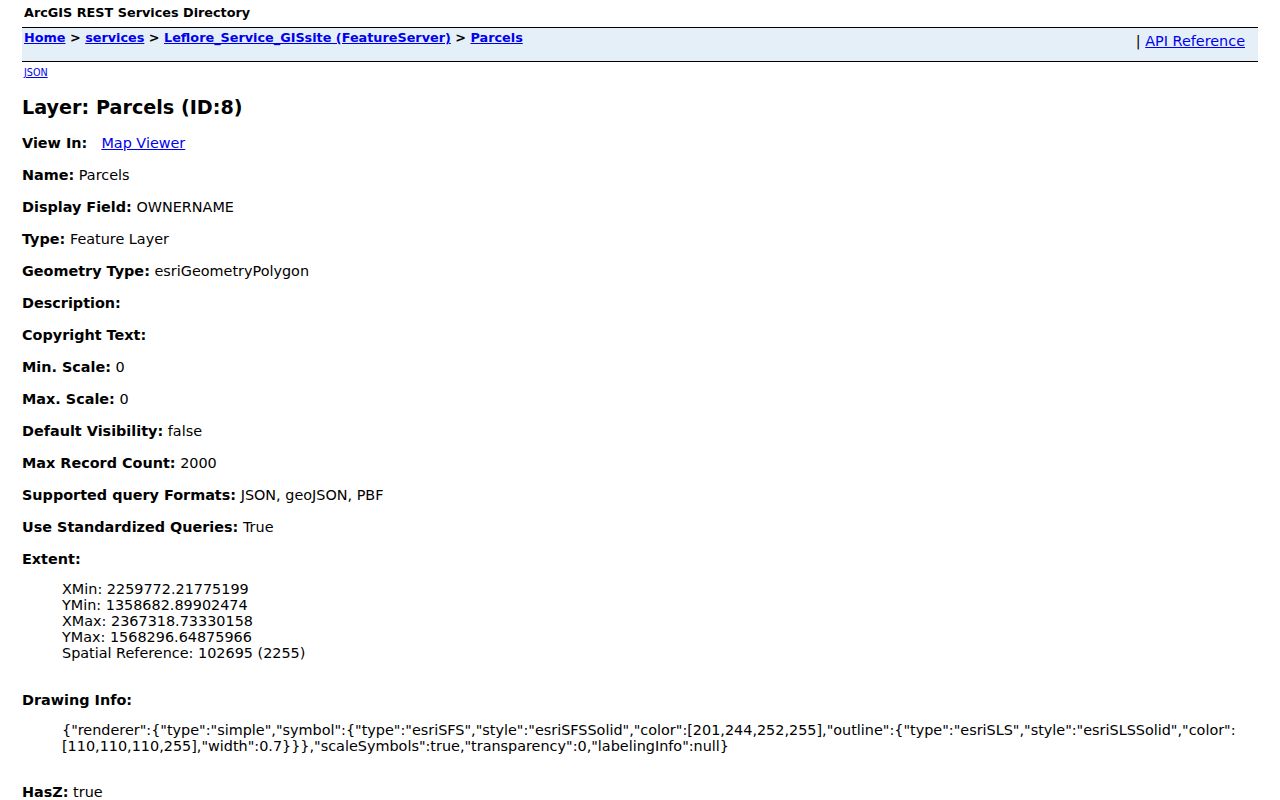
Owner, mailing, situs, and deed fields appear together on one screen.
Test Leflore Roll Freshness
The Tri-State county portal carries an Effective Year 2026 label. That marks its tax year. It does not date the last owner update. Leflore County publishes no closing-to-roll lag or nightly refresh promise, so a newly recorded deed may still name a different owner than the assessment screen shows.
Timing check. Effective Year 2026 is not a guarantee that a recent closing has reached the owner field.
Write down the lookup date and source each time. If ownership changed near that date, let the deed chronology control the next check.
Leflore Mailing and Situs Clues
A mailing city is not a parcel location. The GIS layer separates ADDRESS1–3, city, state, and ZIP from STREET, STREET_NUM, and SITUS_ADDR for exactly that reason. A Greenwood or Itta Bena label may be postal data only. It may not place the tract inside city limits.
Use the current Leflore Parcel Viewer to match the selected polygon to its legal description. A farm tract may lack a street number. One owner may hold several parcels. Location evidence settles both problems.
Confirm Leflore County's Current Owner
The roll starts the current-owner check. The transfer record finishes it, and the parcel card's book, page, and date can go straight to the Chancery Clerk.
- Search PPIN, PARID, or owner on the Tri-State real-property form.
- Match the result to the GIS polygon and copy its deed book, page, and date.
- Ask the Chancery Clerk whether that is the latest recorded conveyance.
- Read the deed's grantee and vesting language, then retain the mailing address only as a contact clue.
- Owner of record
- The party named on the current roll or land record.
- Vesting
- The deed language describing how title is held.
- Registered agent
- A listed contact for an entity, not necessarily the landowner.
Check a Leflore Entity Owner
An LLC or corporation in OWNERNAME calls for a second lookup. Search the exact legal name in the Mississippi Secretary of State portal. It supports business name, ID, officer, and registered-agent queries. Entity status and contacts show whom to approach. It does not prove the entity owns the parcel.
Trust and estate labels demand different care. A deed may recite a trustee's capacity, a life estate, or a fiduciary transfer. A pending Chancery probate file can explain a name that lingers. A decedent's name still sits on the roll until that file closes.
Use Leflore Deed References
The parcel layer's deed references are unusually helpful. One agricultural parcel points to book 326, page 113, dated January 8, 1988. Another cites book 410, page 20, dated September 17, 2008. These are field examples only. Later instruments may exist.
Leflore County offers no official remote deed-index screen. Call 662-453-6203 with the parcel ID, current owner name, legal description, and known book/page, and ask for index confirmation plus the cost of an uncertified or certified copy.
Note: Keep leading zeros in parcel IDs when moving between the GIS layer, tax form, and clerk request.
Contact a Leflore Property Owner
The tax mailing address is the standard contact clue. The addressee may be a trustee, company, or agent. Send a brief written inquiry naming the parcel and purpose. Do not treat it as the owner's home. Mississippi's Address Confidentiality Program can substitute a mailing address for qualifying victims, so a protected residential address should never be sought through unrelated property records data.
Lawful use. Contact data may support a purchase inquiry, boundary question, or estate matter. It must never be used to stalk, threaten, or harass a person.
A solid owner-of-record result for Leflore County keeps four things attached. Those things are the official name, the source date, the parcel number, and the newest deed evidence. When details conflict, the record custodian settles it. Keep a copy of the tax roll entry and the recorded deed side by side.
Entity names call for one extra step. If OWNERNAME shows a company, the Mississippi Secretary of State business search can pull its registered agent, officers, filing address, and status. You can search it by business name, ID, officer, or agent. Those filings help separate lookalike entities. They also give you a contact route. What they cannot do is prove who owns the parcel. Keep the roll name exactly as written. Then compare it against the grantee style on the recorded deed.
Trusts raise a different wrinkle. A trust may show up under a trustee's name. It may also appear under a shortened trust name instead of its full title. Estate wording points to the Chancery Court probate file. That file also holds any executor, administrator, commissioner, or fiduciary deed filed there. Even so, the final owner-of-record conclusion rests on the newest recorded conveyance. That conveyance must match the legal description. A mailing address alone will not carry that weight. Neither will an entity filing.
Write down the date of every office response or document you save. That habit makes later changes in the tax roll or deed index simple to explain.